Why Augusta Yards Hold Water: The Red Clay Problem
Most of the CSRA sits on Cecil series soil — the red clay under practically every lawn from Summerville to Grovetown. It barely absorbs water, so rain has nowhere to go but sideways — across your yard, into low spots, and toward whatever sits downhill, which is often your house. It swells wet and shrinks dry, building hydrostatic pressure against slabs and crawlspace walls until water finds its way in. Nationally, typical foundation repairs average around $4,500, and severe cases run far higher; a drainage system that keeps water off the foundation costs a fraction of the repair it prevents.
There's a second Augusta-specific layer: the Savannah River. Close to 20% of Augusta's land lies within a mapped 100- or 500-year floodplain according to the city's floodplain outreach materials. If your property is in or near one of those zones, surface drainage isn't a landscaping nicety. We check the FEMA flood map for your address during every site visit.
5 Warning Signs Your Property Has a Drainage Problem
- Standing water 24+ hours after rain — the water has no path off your lot.
- A soggy, spongy lawn — bare patches and moss where turf should be, plus a mosquito nursery every summer.
- Water marks or dampness in the crawlspace — water is getting under the house and attacking your floor system.
- Erosion channels or washed-out mulch — showing exactly where uncontrolled water runs, cutting deeper every storm.
- Doors sticking, drywall cracks, gaps at trim — early foundation-movement symptoms; catching them now is dramatically cheaper than later.
If you recognize two or more of these, get the yard looked at before the next storm season. The walkthrough is free: call (762) 224-7903.
Drainage Systems We Build
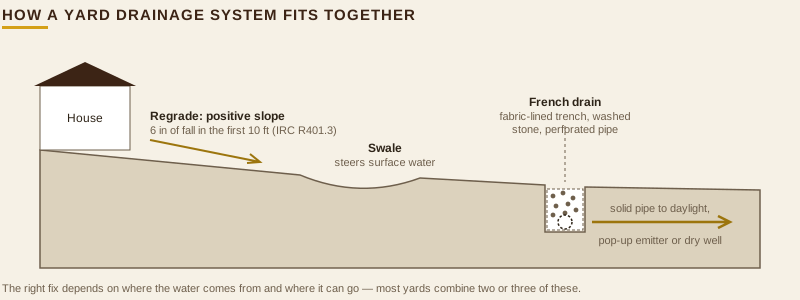
There's no single fix for every wet yard — the right answer depends on where the water comes from, where it sits, and where it can legally go. Here's the toolbox, and when each tool is right:
French Drains
A gravel-bedded perforated pipe in a fabric-lined trench that collects subsurface water and carries it to a discharge point. In Augusta clay, the details decide whether it works for twenty years or fails in two: trench depth and slope, washed stone (not fines that clog), quality filter fabric, and a real outlet — daylight, a pop-up emitter, or a dry well. We dig French drain trenches with machines, not shovels, so the slope is consistent and the system actually drains. See our trenching page for how we handle utilities and locates.
Regrading & Positive Slope
The residential code standard (IRC R401.3) that solves more foundation-moisture problems than any pipe: six inches of fall in the first ten feet away from the house. Decades of settling, flowerbed build-up, and mulch layering leave many CSRA homes with soil sloping toward the slab. We cut and re-establish positive grade with the right fill, compacted so it stays put. Often paired with work from our land grading service.
Swales & Dry Creek Beds
Shallow, shaped channels that intercept surface water and steer it around the house instead of letting it sheet across the lawn. A swale can be nearly invisible in turf; a dry creek bed does the same job dressed in stone. In clay, swales work brilliantly because the water was always going to travel on the surface anyway — we just give it a route you chose.
Catch Basins & Surface Drains
For low spots where water collects — a sunken patio corner, a driveway apron, the bottom of a sloped backyard — a catch basin with buried solid pipe to daylight removes water in minutes instead of days.
Downspout Extensions & Burial
The cheapest big win in drainage. A roof dumps hundreds of gallons per storm, and a downspout that ends 12 inches from the foundation delivers all of it exactly where it does the most damage. We bury solid pipe from each downspout and discharge it well away from the house — often as part of a larger system, sometimes as a stand-alone half-day job.
Our Drainage Process
- Free site walkthrough. We walk the property during or shortly after rain when possible, trace where water comes from and where it sits, check the crawlspace or slab edge, and look up your FEMA flood zone.
- Written plan and firm quote. You get a drawing of what goes where — drains, swales, regrade areas, discharge points — with an itemized written price. No vague "drainage package" line items.
- Locates and dig. Georgia 811 locates are requested before any trenching, as Georgia law requires. Most residential drainage systems take 1–3 days to install; larger regrades or combined systems can run up to a week.
- Test and clean up. We flow-test the system, stabilize disturbed soil with seed and straw or sod prep, and leave you with a yard that sheds the next storm instead of wearing it.
We build drainage across Augusta, Summerville, Hephzibah, Evans, Grovetown, Martinez, and North Augusta SC — anywhere in the CSRA.
Frequently Asked Questions
How do I fix standing water in my yard?
Give the water a route off the property — in Augusta clay it will not soak in on its own. Depending on where the water collects, the fix is a swale or regrade to redirect surface flow, a catch basin in the low spot, or a French drain where water lingers below the surface. We match the system to the yard during a free walkthrough rather than selling one product for every problem.
Does my yard need to be regraded away from the house?
Walk the foundation after a storm: if soil touches the house at a level spot or slopes toward it, yes. The residential code standard is six inches of fall in the first ten feet away from the foundation (IRC R401.3). Most older CSRA homes have lost that slope to settling and years of landscaping build-up, and re-establishing it is one of the highest-value drainage fixes there is — often cheaper than a piped system.
What does a French drain cost in Augusta?
Exterior residential French drain systems commonly run $2,000–$6,000+, driven by trench length, depth, discharge distance, and access for equipment. A short run catching one wet corner sits at the low end; a system wrapping two sides of a house with buried downspouts sits at the high end. We quote a firm written number after measuring the actual yard — free, at your property.
Is my property in a flood zone?
Close to 20% of Augusta's land is in a mapped 100- or 500-year floodplain, concentrated along the Savannah River and the creeks that feed it — so don't assume you're clear just because you've never flooded. Look up your address on FEMA's flood map, or ask us; we check it on every site visit. Being in a zone changes what drainage can and can't do for you, and under Augusta's Flood Damage Prevention Ordinance new construction there generally must be elevated relative to base flood elevation.
Will a French drain even work in red clay?
Yes — when it's built for clay. The mistake is expecting the drain to help water soak into the ground; in clay it can't, so the pipe must physically carry water downhill to a discharge point. That means correct slope, washed stone, filter fabric to keep clay fines out, and a real outlet. Built that way, French drains work as well here as anywhere. Built like a gravel-filled ditch, they fail within a couple of seasons.